



Managing feral and stray cats
Trap-Neuter-Return, or "TNR," is the most humane and effective method available for managing and reducing feral and stray cat populations. The cats living together in a colony are trapped, spayed or neutered, vaccinated for rabies, marked for identification with an eartip and then returned back to their original territory. If resources allow, kittens and friendly adults are removed and placed in homes. Caretakers provide regular food and shelter, monitor the colony for newcomers and handle any issues that arise.
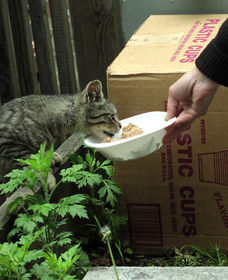
Because the cats can no longer reproduce, the colony has the potential to decline in size over time. Spaying and neutering also greatly reduce nuisance behavior. Once the cats are fixed, fighting, yowling and other noise associated with mating stops almost entirely. The foul odor caused by unaltered males spraying to mark territory disappears and the cats, no longer driven to mate, roam much less and become less visible. Rodent control is maintained by the cats' continued presence.
Like all methods, TNR is most effective when performed well. On a colony level, this means achieving and maintaining a sterilization rate of as close to 100% of the cats as possible and being diligent about their long-term care. On a community level, TNR can best reduce cat populations and complaints when resources, including trappers, spay/neuter surgeries and outreach, are concentrated in sections of the community with high cat populations.
Another significant advantage to TNR is that nothing else works. For decades, the predominant approach was to trap and remove cats from the environment with the end result, especially for ferals, usually being euthanasia. The failure of this policy is evident in the current overpopulation of free-roaming cats throughout the United States. There are too many cats and not enough animal control resources, the public opposes euthanasia, removing one set of cats from a location where food and shelter is available often creates a vacuum for a new set to fill, and the people who feed and care for the cats resist their capture. Other efforts, like feeding bans or laws regulating cat owners, have also failed to make any difference.
TNR, because it is life-affirming, attracts large numbers of volunteers and taps into people's desire to help when they see animals in need. This is why in recent years more and more municipalities and shelters are supporting TNR and developing their own programs. Many communities are now seeing dramatic drops in cat intake and euthanasia numbers because of TNR and other spay/neuter programs - there are even parts of the country where kittens are being imported from other regions! The reality of millions of cats living on the streets is changing at last and TNR is a big part of making that happen.